Asking a colleague for a quick answer versus a considered one. “Off the top of your head, roughly how many?” gets an answer in a second. “Take the afternoon and check it properly” gets a better answer, later. Same person, different effort.
Effort is that dial for a model. The bigger Claude models think before they write, and effort sets how long they may think. In Claude Code you set it with the slash command /effort, which opens a slider, or directly: /effort low, /effort medium, /effort high, /effort xhigh, /effort max.
- The default is right for normal work. It is medium on Opus 5.5, the model Claude Code starts with, and high on the other models.
- Low for chores: reformat this, rename that, quick lookups. Faster and cheaper.
- xhigh and max when the task is genuinely hard and you can wait.
maxlasts for the current session only.
Thinking costs tokens, so higher effort uses more of your allowance and takes longer. The model tier is the bigger dial. Effort is the smaller one, and Anthropic’s own advice is to try turning it before switching models.
What each step costs and buys
An independent benchmark shows it well. Each line is one model, each point one effort level, from low on the left to max on the right:
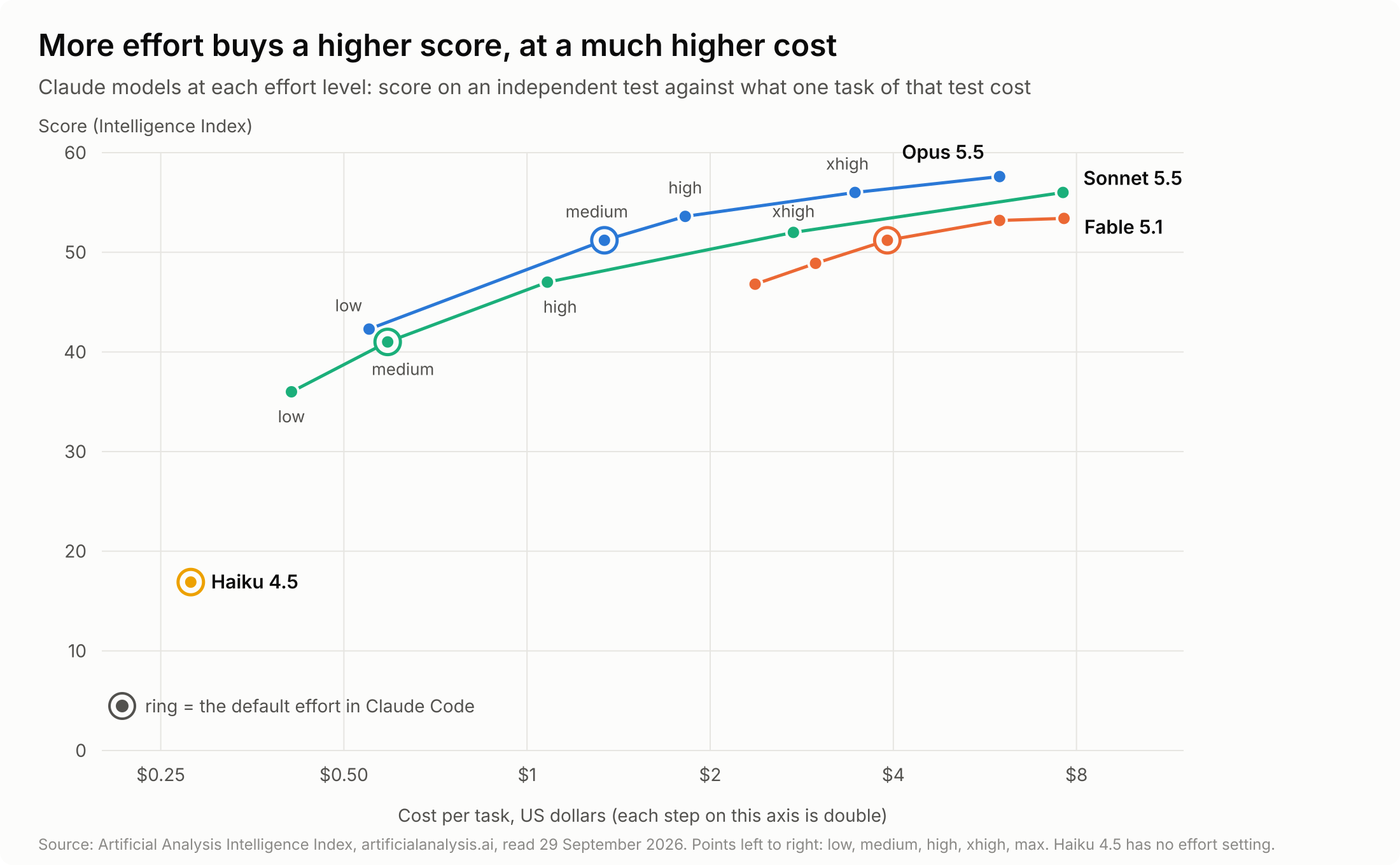
Score against cost per task for each Claude model and effort level. Chart: petr-ai-school, from Artificial Analysis data, 29 September 2026.
- Each step up costs more, often about twice as much as the step before. On Opus 5.5, one task at max costs more than four times what it costs at medium.
- The score rises less and less. On Opus 5.5, from low to medium is a big jump and from xhigh to max a small one. Fable 5.1 hardly gains anything from xhigh to max, and on some tests max is even a little worse than xhigh.
- A stronger model at lower effort often matches a lighter model at max, for less. Opus 5.5 at xhigh scores the same as Sonnet 5.5 at max (56), for less than half the cost per task.
So: stay at the default, go one or two steps up when a task is hard, and use max only when being right matters more than time and allowance.
Example
You ask for a table of every deadline in a folder of contracts. At high effort it finds them and gets one date wrong, because two contracts refer to the same clause. You type /effort xhigh and ask again, and it notices the overlap and flags it. Same model, one more minute.
Why it matters for you
Two dials give you more room than one. When a result disappoints, the order to try is: a clearer prompt, then more effort, then a stronger model from the Claude model family. Most of the time you never reach the third step.
Related
- Claude model family - the bigger dial, and what each tier is for
- Benchmark - where the chart comes from, and how to read one
- Model - what is doing the thinking
- Token - what thinking costs
- Slash command -
/effortand its neighbours